Most business websites do one job well: they tell people who you are and what you offer. But some organisations need their website to do much more than that. They need different people to log in, find the right information, complete a process and manage their own content, all in one place.
That is where a portal comes in. In this post we look at when a brochure site stops being enough, why Payload CMS is a strong foundation for portals, and how we put that into practice for Exeter and North Devon Colleges Group (SW CTEC). If you want a wider introduction first, read our earlier post on portals in web design.
When a website stops being enough
A brochure site is a set of pages. A portal is closer to a working tool. You may need one if:
- Different groups of people need different things from your site, such as prospective customers, existing customers and staff.
- Information is spread across separate systems, so people have to hunt for it and your team has to enter the same thing more than once.
- Several teams or locations each need to look after their own content.
- You want people to complete a process online, such as an application or enrolment, rather than just read about it.
If two or more of those sound familiar, a standard website is probably holding you back.
Why portals need structured content
The pages on a brochure site are mostly free-form. A portal is different, because much of what it shows is data. A course, for example, is not really a page. It is a record with a title, a level, a subject area, a set of start dates, entry requirements and a way of being delivered. Each of those details needs to be stored properly so that it can be searched, filtered and reused.
This is where Payload works well. Because it is built around custom data structures, we can model your organisation as it actually works, rather than forcing it into a template designed for something else. Your team then manages that information through clean, clearly labelled fields in the admin, which keeps the content consistent and makes the site easier to look after.
A real example: SW CTEC
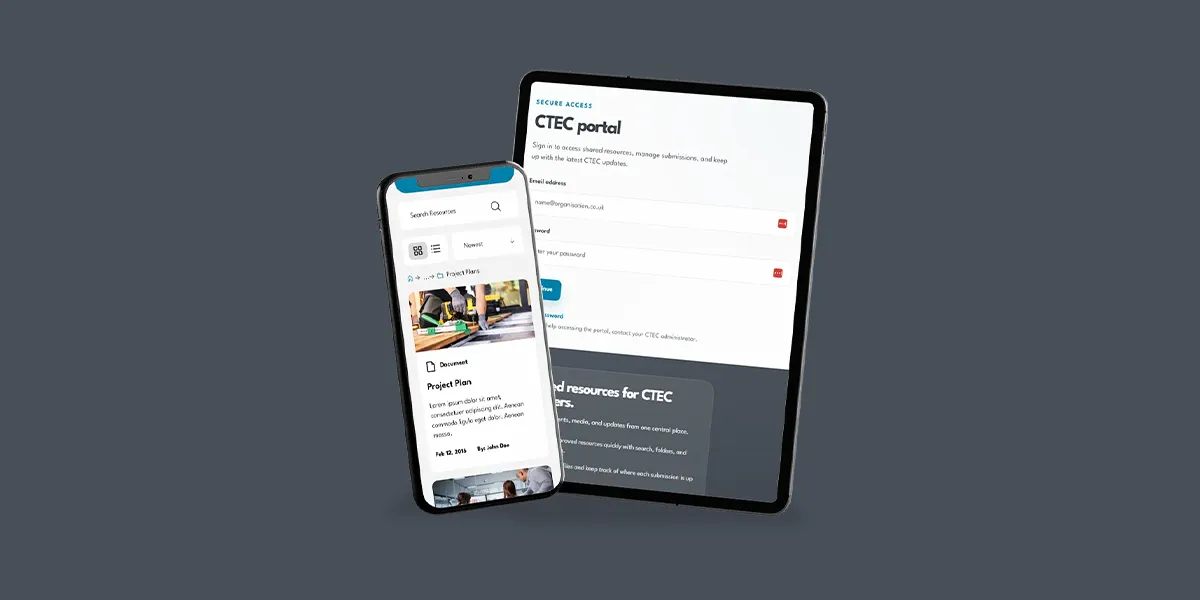
SW CTEC is a partnership of colleges across the South West. Before the project, each college operated within its own systems. That created data silos, an inconsistent experience for students and manual processes that duplicated effort across institutions. Prospective students could not easily see the full range of courses on offer across the group.
The brief was to unite the colleges on one platform without losing the individual character of each. We built a custom portal on Payload CMS. Multiple colleges sit within a single ecosystem, each with its own branding, course catalogue and user management, while sharing a unified backend that streamlines administration. You can read the full story in the SW CTEC portfolio entry.
Course catalogues that people can actually search
A good course catalogue helps someone find the right option quickly, whichever college it belongs to. On SW CTEC, visitors can browse programmes across all the colleges and filter by subject area, level and delivery method. The system handles programme hierarchies, multiple start dates and different ways of studying, including full-time, part-time and online.
Each course has its own detail page covering the curriculum, entry requirements and career pathways, so people have what they need to make a decision. Because all of this is held as structured data, it stays consistent from one course to the next.
Enrolment workflows that guide people through
Finding a course is only half the journey. The enrolment workflow was designed to take prospective students smoothly from discovery through to application, with an integrated application system that makes each step clear. Student portals then give secure access to course materials, progress tracking and essential college information.
The aim with any workflow like this is the same: remove the friction, so that someone who is ready to apply can do so without having to work out what happens next.
Staff who can manage their own content
A portal that only a developer can update will quickly go out of date. For SW CTEC, staff at each college keep control of their own content and data through an intuitive interface, and they do not need technical expertise to use it. The shared structure keeps everything consistent, while each college retains its own identity.
That balance between central consistency and local ownership is one of the things Payload does particularly well, and it is the same thinking behind our multi-location builds.
Is a portal right for you?
A portal is a bigger investment than a brochure site, and it is not right for everyone. A few questions can help you decide:
- Do different groups of users need different information or access?
- Are you repeating work because information lives in more than one place?
- Would your team benefit from managing parts of the site themselves?
- Is there a process you would like people to complete online?
If the answer to most of those is yes, it is worth exploring. We will give you a straight answer on whether a portal makes sense, or whether a well-built website would do the job.
Thinking about a portal?
To see more of what we have built, browse our portfolio. And if you would like to talk through what a portal could do for your organisation, get in touch or call us on 01752 395600.